
Tournament / WCVL Rules
https://www.wcvl.ca/media/WCVL-EXECUTIVE-POLICY.pdf
- Males can only attack the ball from behind the 3-meter attack line. At take-off, his feet must neither have touched, nor crossed over the attack line. After his hit, he may land on or in front of the attack line. However, he may complete an attack hit in front of the attack line if at the moment of contact any part of the ball is below the top of the net.
- If a male puts the ball over the net while jumping in front of the attack line, that is considered an attack (blocking not included).
- Because this comes up often, dumps are attacks. Standing dumps are still attacks if the ball is fully above the height of the net and directed down.
-
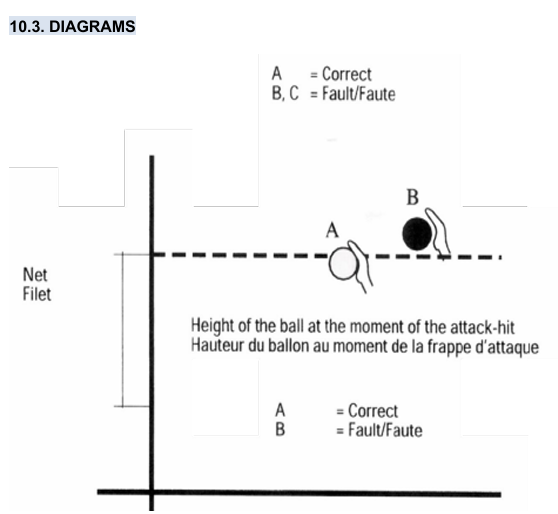
- If a male puts the ball over the net while jumping in front of the attack line, that is considered an attack (blocking not included).
- You are also not allowed hit overpasses. You are however allowed to block them, and break your wrists. But when doing this, be careful to use two hands, otherwise there is a high chance that your block will actually be an attack. This includes sets.
- Side-by-side blocking (attempted or completed) by 2 males is only allowed against a male attacker, otherwise a participating female blocker must be present between 2 male blockers for the block to be legal. 2 males blocking a female side-by-side is not allowed; if two males jump together but one pulls his hands down, that is still considered a double male block
- Breaking wrists with blocking is allowed; however males blocking with one hand should avoid breaking their wrists as there is an extremely high chance of that actually being a hit. There is a difference between breaking your wrists on a reaching, one-handed block against a hit, and using one hand to throw down an overbump.
- When your team is serving, no screening with hands above head. Hands are still allowed to be beside or on your head head (this is also a new Volleyball Canada rule from this year)
Volleyball Canada Rules that are often contested/unknown
- Section 11.4) Contact with the net by a player between the antennae, during the action of playing the ball, is a fault. The action of playing the ball includes (among others) take-off, hit (or attempt) and landing safely, ready for a new action.
- (Section 11.4.4) Players may touch the post, ropes, or any other object outside the antennae, including the net itself, provided that it does not interfere with play. When the ball is driven into the net, causing it to touch an opponent, no fault is committed.
- (Section 11.1) A player may not touch the ball or an opponent in the opponent’s space before or during the opponent’s attack hit.
- (Sections 11.2, 11.4) It is permitted to penetrate into the opponent's space under the net, provided that this does not interfere with the opponent's play. A player’s foot (feet) has to completely penetrate [full foot/feet] into the opponent’s court or interfere with the opponent’s play while penetrating into the opponent’s space under the net to be called on a fault.
- Having said this, penetrating under the net is quite dangerous when hitting or blocking, and having a player land on your foot when you have crossed the line is interference (and hopefully not an injury on their part).
- NEW (Section 12.5.2) Any player of the serving team is forbidden to raise hands above the head during service, until the ball has passed beyond the net.